
You don’t need forty five minutes and a gym bag to get real training value. A well built 20 minute home workout no equipment routine can raise your heart rate, build strength endurance, and leave you genuinely fatigued if the structure is right.
The problem with most short workout articles is that they hand you a list of exercises and call it a day, without explaining how those exercises fit into an actual 20 minute block. Below is a full structure you can follow today, along with how to adjust it based on your current fitness level.
What Exactly Should You Do During Those 20 Minutes?
The short answer: a brief warm up, three rounds of a work and rest interval circuit, and a short cool down. Here’s how that breaks down.
Structure at a glance:
- Minutes 0 to 3: Warm up
- Minutes 3 to 17: Three rounds of six exercises
- Minutes 17 to 20: Cool down and stretching
Quick Warm Up (3 Minutes)
Move through these for 30 seconds each, no rest between:
- Marching in place
- Arm circles
- Bodyweight squats
- Hip circles
This raises core temperature and prepares the joints without draining energy before the main workout.
The Main Circuit
This circuit uses a 40 seconds work, 20 seconds rest format, repeated for three full rounds. That’s roughly 14 minutes of actual training. Also read Bodyweight Workout Routine: A Practical Beginner to Intermediate Plan.
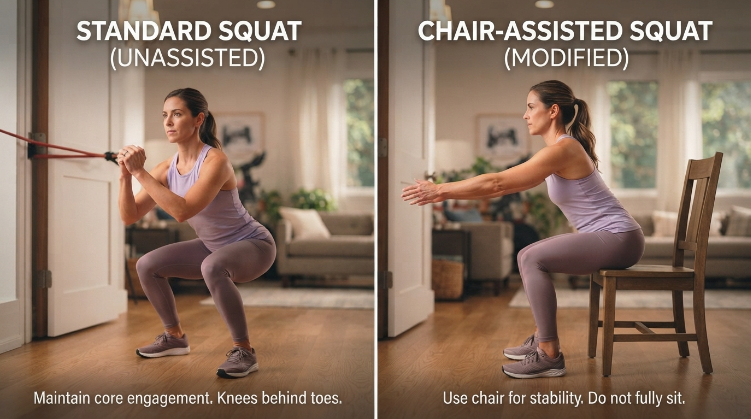
- Squats – builds leg and glute strength through a full range of motion.
- Push ups – trains chest, shoulders, and triceps using bodyweight resistance.
- Mountain climbers – raises heart rate while engaging the core and hip flexors.
- Glute bridges – targets the glutes and lower back, balancing out the pressing movements.
- High knees – a cardio focused movement that also challenges coordination.
- Plank hold – builds core stability and finishes each round with controlled tension.
After completing all six movements, that’s one round. Rest 60 seconds, then repeat two more times.
Cool Down (3 Minutes)
Slow marching for 30 seconds, followed by static stretches for the hamstrings, quads, chest, and shoulders held for 20 to 30 seconds each. This helps bring your heart rate down gradually rather than stopping abruptly.
Beginner Version
If 40 seconds of continuous work feels too demanding early on, shift to a 30 seconds work, 30 seconds rest format instead. Substitute:
- Squats stay the same, or use a chair squat for support.
- Push ups become knee push ups or wall push ups.
- Mountain climbers become slow marching in place.
- High knees become marching with a higher knee lift.
The goal at this stage is finishing all three rounds with control, not maximum intensity.
Intermediate Version
Once the standard format feels manageable, increase the challenge by extending work intervals to 45 seconds with only 15 seconds rest, or adding a fourth round. Another option is adding tempo, such as a two second pause at the bottom of each squat.
Low Impact Option
For anyone dealing with joint sensitivity or preferring a quieter workout, swap high impact movements:
- Mountain climbers become slow plank shoulder taps.
- High knees become standing marches with arm drives.
- Everything else in the circuit stays the same.
This keeps the intensity and muscular engagement similar while removing repeated impact on the knees and ankles.
How to Adjust Intensity Without Changing the Exercises
From a programming perspective, intensity in a bodyweight circuit comes from three levers: work to rest ratio, tempo, and range of motion. You don’t need new exercises to make a workout harder or easier, you just need to adjust one of those three variables.
How Often to Do This Workout
Three to four times per week works well for most people using this as a general fitness routine, with at least one full rest day between sessions if you’re also doing other physical activity.
The HHS Physical Activity Guidelines recommend adults get at least 150 minutes of moderate intensity activity weekly, and four sessions of this circuit gets you most of the way there on its own.
How to Progress This Workout Over Time
Progression doesn’t require new movements every week. A practical approach I recommend is sticking with the same six exercises for three to four weeks, tracking how many full reps you complete within each 40 second window, and aiming to slightly beat that number over time.
Once that plateaus, increase the round count or extend the work interval before changing the exercises entirely.
Fitting This Into a Busy Schedule
One mistake I often see people make is waiting for a “perfect” time slot that never comes. This workout is built specifically to fit into a lunch break, before a morning shower, or right after logging off work. Doing it consistently at a fixed time, even an imperfect one, matters more than finding the ideal moment.
Real World Application

Hypothetical Example: Consider someone with a demanding nine to five schedule who struggles to find time for a full gym session.
Committing to this 20 minute circuit four mornings a week before work, without needing to travel anywhere or change into gym clothes, is a realistic way to accumulate consistent training volume across a month.
Over time, small improvements in reps completed per interval reflect genuine gains in strength endurance, even without any added equipment.
Conclusion
A 20 minute home workout no equipment session works because of structure, not because of the exercises alone.
Warm up properly, follow the work to rest ratio, and adjust intensity as you improve rather than switching exercises constantly.
Try this exact circuit three times this week and notice how your interval performance changes by the third session.
FAQs
Can a 20 minute home workout no equipment routine really build fitness?
Yes, when it combines strength and cardio movements with structured work and rest intervals. Consistency over weeks matters more than the length of any single session.
What if I can’t finish all three rounds at first?
Complete as many rounds as you can with good form and rest a bit longer between them. Building up to three full rounds over a couple of weeks is completely normal.
Is this workout enough to lose weight?
Weight change depends on multiple factors including overall diet and activity levels, and no single 20 minute workout can guarantee fat loss. This routine can be a useful part of a broader consistent activity habit.
Do I need to warm up for such a short workout?
Yes. Even a brief three minute warm up reduces injury risk and improves performance during the main circuit, especially for movements involving the knees and shoulders.
How is this different from a full length home workout?
This routine is deliberately time capped and interval based, prioritizing efficiency over volume, which makes it more suitable for tight schedules than longer, exercise heavy routines.
Can I do this every day?
Most people do better with three to four sessions a week combined with rest or light activity on other days, since full recovery supports better performance and reduces overuse issues.
What’s the best time of day to do a 20 minute no equipment workout?
Whatever time you’ll actually stick to consistently, whether that’s early morning, a lunch break, or right after work.