
A resistance band workout at home can build real strength when the bands are used with intention rather than just stretched back and forth for the sake of movement. I’ve watched plenty of people buy a set of bands, do a few random pulls in front of the TV, and wonder why nothing changes. The bands aren’t the problem. The way they’re used usually is.
This guide walks through a complete, structured resistance band workout at home, including how to choose the right band, how to set up tempo and rest, and how to progress the resistance over time so your training actually goes somewhere.
What Resistance Band Training Actually Is
Resistance bands work through elastic tension instead of gravity. As you stretch a band further, the resistance increases, which means the hardest part of most band exercises is usually the top of the movement rather than the bottom. This is different from a dumbbell, where tension stays fairly constant throughout the range of motion.
That difference matters for programming. Bands are excellent for building muscular endurance, reinforcing control through a full range of motion, and adding resistance to bodyweight movements that would otherwise plateau quickly.
Why Bands Work Well for Home Training
Bands are lightweight, inexpensive, and take up almost no storage space, which makes them practical for apartments, hotel rooms, or anyone who travels often.
According to physical activity guidance from the CDC, adults benefit from muscle strengthening activity at least twice a week, and resistance bands are a legitimate way to meet that recommendation without a gym membership. Also read Strength Training for Beginners at Home: Your No Gym 4 Week Starting Plan.
Loop Bands vs Tube Bands
There are two common types you’ll come across:
- Loop bands (mini bands): Closed loops, usually used around the legs or arms for glute and shoulder work.
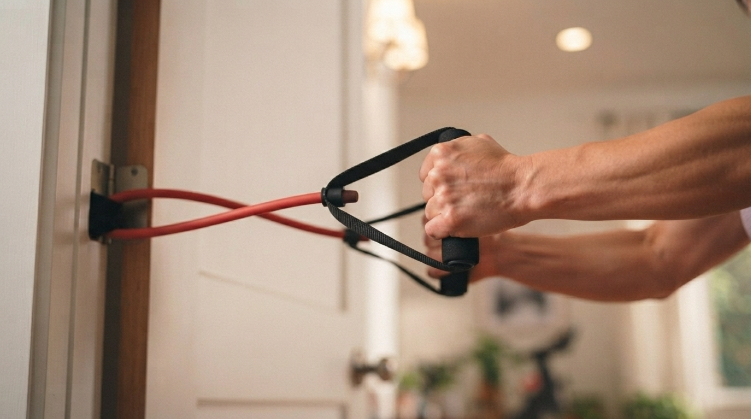
- Tube bands with handles: Longer bands with handles on each end, often used for pressing, rowing, and pulling movements, sometimes with a door anchor.
A practical approach I recommend to beginners is starting with one loop band and one medium resistance tube band. That combination alone covers most of a full body routine.
Choosing the Right Resistance
Band resistance is usually labeled light, medium, heavy, or by color, but the label matters less than how the band actually feels in the movement.
A band is appropriately challenging when you can complete all the prescribed repetitions with good form, but the final two or three reps feel genuinely difficult.
If you’re breezing through 15 reps with no fatigue at all, the band is too light for that exercise. If your form breaks down halfway through the set, it’s too heavy.
Warm Up Before You Start
Spend five minutes on light movement before loading any band. Bodyweight squats, arm circles, and a few slow lunges are enough to raise your body temperature and prep the joints, particularly the shoulders and hips, which take on a lot of tension in banded work.
The Full Body Resistance Band Workout
Here is a complete routine. Perform it two to three times per week, resting at least one day between sessions. Also read Bodyweight Workout Routine: A Practical Beginner to Intermediate Plan.
| Exercise | Sets | Reps | Rest |
| Banded squat | 3 | 12-15 | 45 sec |
| Band row (tube, anchored) | 3 | 12-15 | 45 sec |
| Band chest press | 3 | 10-12 | 45 sec |
| Banded glute bridge | 3 | 15 | 30 sec |
| Band shoulder press | 3 | 10-12 | 45 sec |
| Standing band core rotation | 3 | 10 per side | 30 sec |
Banded squat: Standing on the band with it looped around the shoulders or held at chest height builds leg strength while the resistance increases exactly when it should, near the top of the movement.
Band row: Anchored rows target the mid back and rear shoulders, muscles that get neglected in a lot of home routines because there’s no barbell to row with.
Band chest press: Anchoring the band behind you and pressing forward mimics a cable press and keeps constant tension on the chest and triceps.
Banded glute bridge: Adding a loop band above the knees during a bridge forces the glutes to work against outward pressure, which most bodyweight bridges don’t challenge.
Band shoulder press: Standing on the band and pressing overhead builds shoulder strength while also demanding core stability to keep you upright.
Band core rotation: Anchoring the band at chest height and rotating away from it trains the core to resist rotation, which carries over to almost every real world movement.
Sets, Repetitions, and Tempo
For most home lifters, three sets of 10 to 15 repetitions per exercise builds a good balance of strength and muscular endurance. Control the tempo rather than rushing it.
A useful way to think about this is a two second stretch phase, a brief pause at full tension, and a two to three second controlled return. Slowing the return is where a lot of the actual muscle work happens with bands, since a fast release just lets the elastic snap back for you.
Creating Progressive Overload With Bands
Progressive overload doesn’t disappear just because you’re not using plates. From a programming perspective, you can progress a resistance band workout at home in several ways:
- Move to a heavier band once 15 reps feel comfortable with good form.
- Increase time under tension by slowing the tempo further.
- Shorten the band or change your grip to increase starting tension.
- Add an extra set once your recovery allows it.
- Stack two bands together for advanced strength work.
Common Resistance Band Mistakes
One mistake I often see beginners make is letting the band snap back quickly at the end of a rep. This removes tension from the muscle and puts unnecessary strain on the joints. Another common error is anchoring the band somewhere unstable, like a doorknob, which can fail mid rep.
Beginner Modifications
If a full standing band squat feels unstable, try it seated on a sturdy chair first, using the chair as a depth guide. For pressing movements, start with a lighter band and focus purely on smooth, controlled reps before increasing resistance.
Weekly Schedule
A simple weekly approach for someone new to resistance band training at home looks like this:
- Monday: Full body band workout
- Tuesday: Rest or light walking
- Wednesday: Full body band workout
- Thursday: Rest
- Friday: Full body band workout
- Weekend: Rest or active recovery
Real World Application
Hypothetical Example: Consider someone returning to exercise after a long break, with no gym access and limited space at home.
Starting with two light to medium bands, three sessions per week, and gradually increasing resistance over six to eight weeks is a realistic and sustainable way to rebuild strength without any specialized equipment.
This kind of progressive approach aligns with general strength training guidance from the American College of Sports Medicine, which emphasizes gradual increases in training stimulus for continued adaptation.
Conclusion

A resistance band workout at home only works as well as the structure behind it. Choosing the right resistance, controlling tempo, and applying progressive overload over weeks turns a simple set of bands into a legitimate strength tool.
Start with the routine above, stay consistent for a few weeks, and adjust resistance as the current bands stop feeling challenging.
FAQs
Is a resistance band workout at home actually effective for building strength?
Yes, when the band resistance is challenging enough and progression is applied over time. Bands create variable tension that increases through the range of motion, which can build meaningful strength, particularly for beginners and intermediate lifters.
How many resistance bands do I actually need to start?
Two is usually enough to begin: one loop band for lower body and core work, and one tube band with handles for pressing and rowing movements.
Can resistance bands replace weights completely?
For many people, yes, especially at a beginner to intermediate level. More advanced lifters may eventually want to combine bands with dumbbells or a gym program for continued progress.
How do I know when to move to a heavier band?
If you can complete all prescribed reps with two or three left in reserve and good form, it’s time to progress to a slightly heavier band.
Are resistance bands safe for people with joint issues?
Bands can be joint friendly because they avoid sudden impact, but anyone with an existing injury or medical condition should consult a qualified healthcare professional before starting a new routine.
How often should I do a resistance band workout at home each week?
Two to three sessions per week, with at least one rest day between sessions, works well for most people building general strength.
Do resistance bands lose their tension over time?
Yes, bands naturally wear down with repeated use and should be replaced if you notice cracking, thinning, or reduced resistance.